Yellow Iris
Help report populations of yellow iris in the Lake Wingra Watershed
by Sarah Kraszewski, Board Member
Yellow iris (Iris pseudoacorus) is a non-woody perennial plant that is native to Eurasia and can escape from water gardens and ponds into natural environments in Wisconsin. This species can spread into forests, lakes, streams, ponds, and various wetland types including bogs, swamps, and marshes. Other names for this plant include yellow flag iris, European yellow iris, and pale-yellow iris.
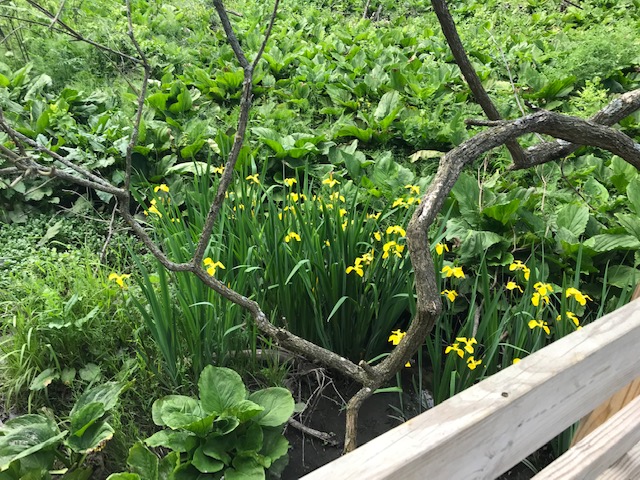
I first reported this plant to the Wisconsin Department of Natural Resources (WDNR) above the dam and along the northeast shore of Lake Wingra in 2017. Since that time, I have observed the spread of isolated clumps along the Lake Wingra shoreline, into the adjacent marshes, and into wetlands of the UW Arboretum including Wingra Woods by the skunk cabbage bridge.
Ecological Threat:
Dense clumps and mats of yellow iris can trap sediment and may alter how water is distributed and moves through waterbodies and wetlands. Yellow iris can outcompete native aquatic plants that contribute to plant species diversity and wildlife food and habitat. This plant is not a food source as all parts of the plant are poisonous.
Yellow iris is classified as a Restricted species on the WDNR Invasive Species Rule (Wis. Admin. Code NR 40), which indicates that the species is already established in the state and causes or has the potential to cause significant harm to the environment, the economy, or human health. The Invasive Species Rule makes it illegal to transport, transfer, or introduce the listed species without a permit.
Spread:
This plant spreads by seed and vegetatively by rhizome fragments. Each fruiting capsule may have over 100 seeds. Seeds have a hard outer casing with a small air space underneath, which allows the seeds to float and spread from the parent plant. The plant can form dense clumps or floating mats.
Identification:
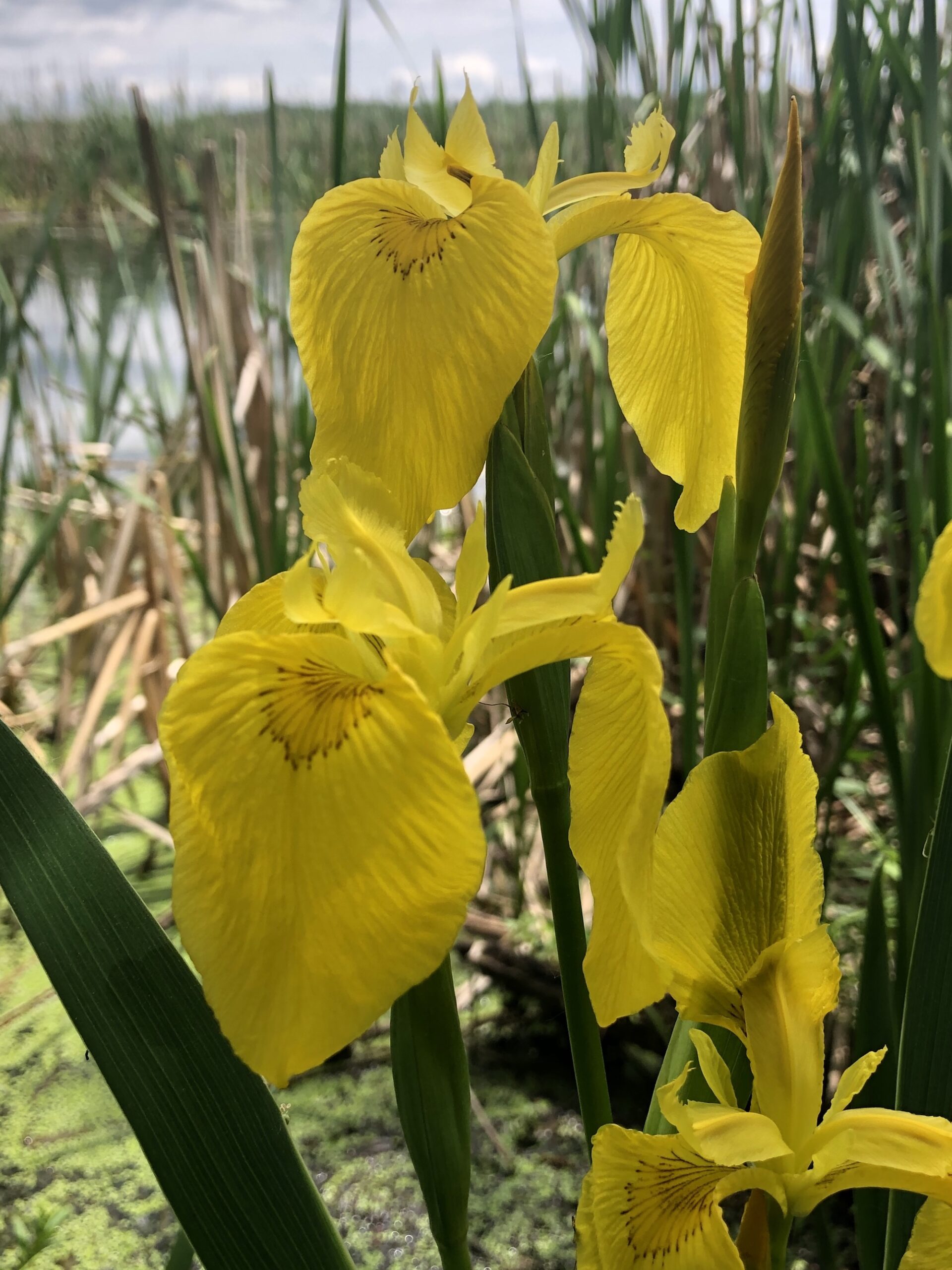
This plant has broad, sword-shaped leaves that grow upright. Leaves are green with a slight blue-grey tint. Flowers grow on 3-4 feet tall stems that are usually as tall or taller than the leaves. The flowers are yellow, ranging from very bright yellow to cream/almost white. There are three upright petals and three downward pointing petal-like sepals that may have streaks of other colors. Flowering is observed in our region from May-June. After blooming, seed capsules are formed that are 6-angled and 2-4 inches long.
This plant is challenging to distinguish from our native blue flag iris (Iris versicolor) and other ornamental irises that are not invasive and could be confused with other wetland plants when it is not flowering. The best time to identify this plant is when the yellow flowers are present.
Reporting:
Please report observations of yellow iris in the Lake Wingra Watershed in 2026 using the link above. Please take a photo of the plants and an overview photo of the area you saw the plants to submit with your form.We will collect your observations to inform the WDNR and landowners such as the UW Arboretum and City of Madison Parks Department. Our goal is to work with these groups to create a management plan and act while the populations are at a level that can still be controlled.
References:
Below are references used to create this article and webpages that you can go to for more information and photos.
WDNR: https://dnr.wisconsin.gov/topic/Invasives/fact/YellowFlagIris
Invasive.org: https://www.invasive.org/browse/subject/5853?tab=subject-info
Minnesota Wildflowers: https://www.minnesotawildflowers.info/flower/pale-yellow-iris
Landscaping Alternatives for Common Invasive Wetland and Aquatic Plants: https://hort.extension.wisc.edu/files/2023/10/WY0110_LandscapingAlternatives_AquaticInvasivePlants-1.pdf