
Thawing of Lake Wingra
Thawing of Lake Wingra
By David Ortiz, Board Member
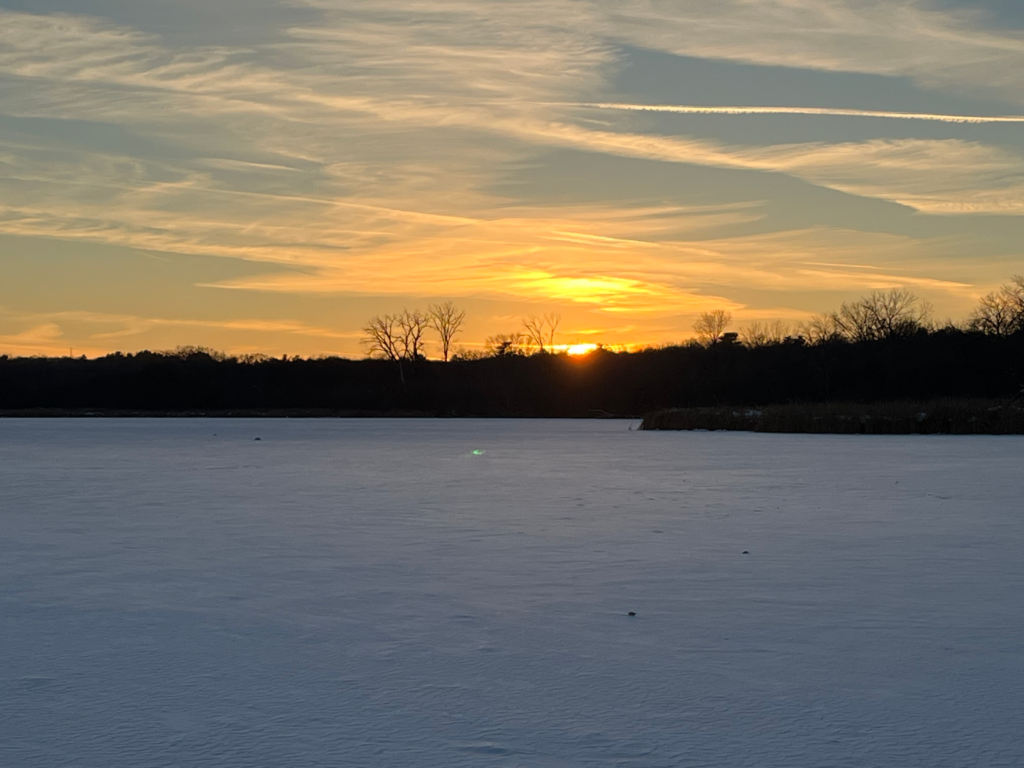
If you spend time near Lake Wingra during the winter, you may have noticed shorter durations of ice cover, a trend seen in lakes across the globe1. The shortest period of ice cover on Lake Wingra occurred during the winter of 2023-2024, with only 63 days of ice cover – 50 days less than the historical average of 113 days, based on records dating back to 1877.
A lake is classified as frozen when its surface is covered by at least 50% ice. Scientists at the Wisconsin State Climatology Office at the University of Wisconsin-Madison campus monitor ice cover on Madison’s lakes from the rooftop of a 13-story building to determine the date each year that the lakes freeze. Lakes can have multiple freeze dates in a single season if warm or windy conditions melt the initial ice cover and are followed by another cold period.
As lakes cool through fall and winter, the density of the water changes. Freshwater is densest at 4° C (39.2° F), causing it to sink to the bottom and leaving slightly warmer water near the surface. However, on especially cold days, the surface water can cool enough to freeze. Ice is approximately 9% less dense than water, allowing it to float. This is the same property that allows oil to float on top of water. As the ice expands across the surface and thickens, it insulates the water below, preventing the entire lake from freezing solid.
Local records show a reduction in ice duration across all Madison lakes. Lake Wingra has lost an average of 0.4 days of ice cover per year since 1968 (Figure 1A). Shorter periods of ice cover affect both lake ecology and recreational opportunities. For a community engaged in outdoor activities year-round, this means less ice fishing, skating, and unique walks on a frozen lake.
From an ecological perspective, shorter ice-cover periods could affect fish in several ways. It could cause a shift in the fish community towards species that prefer warmer waters, such as carp or bass2. Fish species that lay eggs under ice may experience increased predation on their eggs and young of the year by warm-water species. Changes in the timing of ice-on and ice-off could also alter the relationship between fish hatchlings and plankton3. If these events are out of sync with each other, the young-of-the-year fish may experience food shortages during critical periods of development.
If a lake thaws while the surrounding watershed’s soil is still frozen, nutrients may enter the lake more quickly, fueling early algal growth rather than slowly infiltrating through the soil4. Later ice formation also extends the period during which aquatic plants and algae can continue growing into the fall5. Finally, increasing the time lakes are exposed to the atmosphere also increases evaporation, which may intensify low water levels during drought years1.
Ice cover durations have varied by as much as 80 days over the past 57 years. Although ice cover naturally varies from year to year (Figure 1B), the general upward trends have been attributed to increasing temperatures from climate change. In the Madison area, average daily high and low temperatures during the winter months of December, January, and February have steadily increased, corresponding with the loss of ice cover on Lake Wingra.
Global weather patterns can also influence lake ice cover, particularly El Niño and La Niña. This year, we are currently experiencing a strong El Niño event, meaning that the Pacific Ocean will experience weaker east-to-west winds, allowing warm water and air to travel across North America, setting the stage for a short ice period in Madison6.
Ice cover is very important to the lake ecosystems and how we recreate on lakes in the winter. Although lake ice conditions vary greatly from year to year, the long-term trend is clear: ice cover is becoming shorter. We cannot confidently predict when ice will form or thaw on Lake Wingra any given year, but continued monitoring of the ice conditions and lake ecology can help us better understand the changes to come. As ice covered winters are becoming shorter, opportunities to safely enjoy Lake Wingra will also decrease, making periods when the lake freezes all the more special and worth savoring.
Data availability statement
The temperature data were downloaded from the National Oceanic and Atmospheric Administration Climate Data Online Tool (https://www.ncei.noaa.gov/cdo-web/) that were collected at the Dane County airport (station ID:USW00014837). Lake Wingra ice cover data were downloaded from the Wisconsin State Climatology Office (https://climatology.nelson.wisc.edu/first-order-station-climate-data/madison-climate/lake-ice/.
Ice safety disclaimer
Recreating on the ice can be dangerous and we highly suggest that you check the Wisconsin Department of Natural Resources for information about ice safety (https://dnr.wisconsin.gov/Education/OutdoorSkills/IceSafety) and check trusted reportings of ice thickness before heading on the ice.
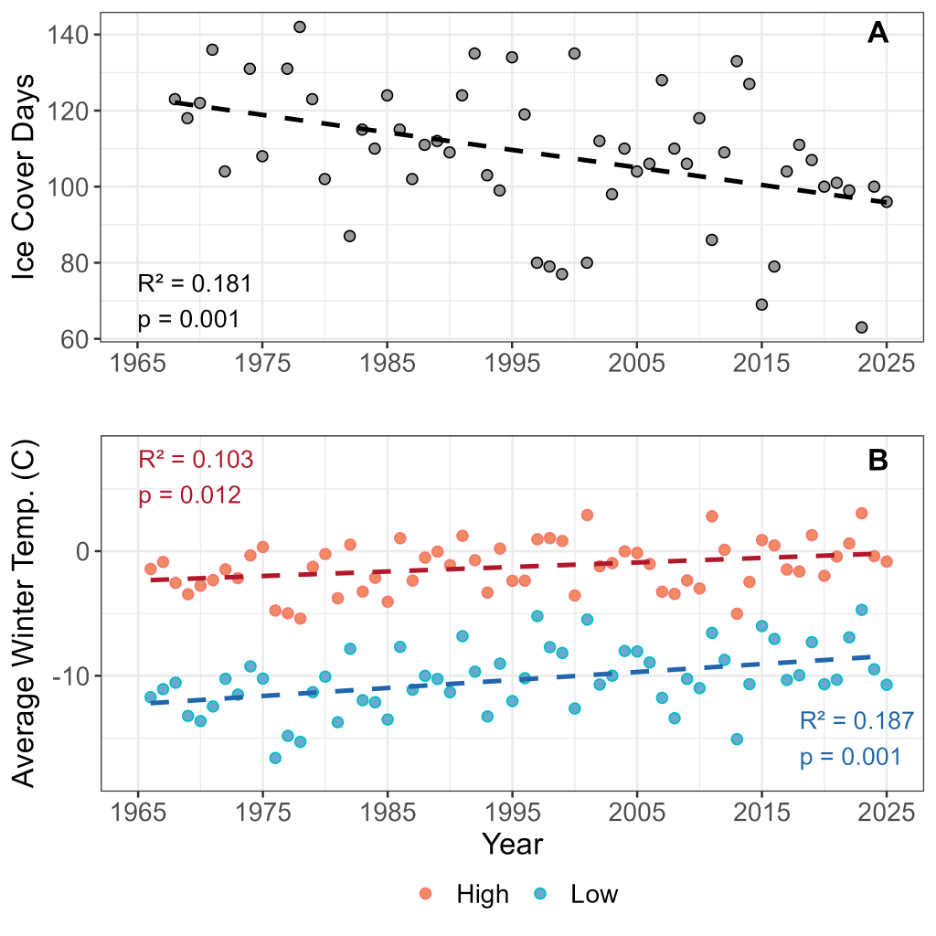
Figure 1. Temporal trends of A) ice cover duration on Lake Wingra and B) average winter temperature highs and lows. Dashed lines are significant linear regressions, with each summary of the relationship in the corresponding color.
References
1. Woolway, R. I. et al. Global lake responses to climate change. Nat Rev Earth Environ 1, 388–403 (2020).
2. Helland, I. P., Finstad, A. G., Forseth, T., Hesthagen, T. & Ugedal, O. Ice-cover effects on competitive interactions between two fish species: Ice-cover and competition. Journal of Animal Ecology 80, 539–547 (2011).
3. Culpepper, J. et al. Lake ice quality in a warming world. Nat Rev Earth Environ 5, 671–685 (2024).
4. Sharma, S. et al. Loss of Ice Cover, Shifting Phenology, and More Extreme Events in Northern Hemisphere Lakes. JGR Biogeosciences 126, e2021JG006348 (2021).
5. Ejankowski, W. & Lenard, T. The effect of ice phenology exerted on submerged macrophytes through physicochemical parameters and the phytoplankton abundance. J Limnol 75, (2016).
6. Ghanbari, R. N., Bravo, H. R., Magnuson, J. J., Hyzer, W. G. & Benson, B. J. Coherence between lake ice cover, local climate and teleconnections (Lake Mendota, Wisconsin). Journal of Hydrology 374, 282–293 (2009).