
Zebra Mussels and the Future of Lake Wingra
by David Ortiz, Board Member
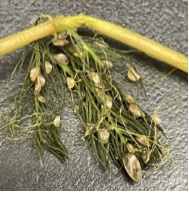
Primarily juvenile zebra mussels on an aquatic plant from Lake Mendota 2022.
Photo taken by David Ortiz
During the yearly removal of docks from Wingra Boats (in Wingra Park) in October 2024, zebra mussels were found for the first time within Lake Wingra. Surprisingly, it took nearly 15 years for zebra mussels to reach Lake Wingra—especially since Lake Monona is just half a mile away. “I was saddened when I pulled up the pier section and saw the mussels, but not surprised as I see them on our piers in Lake Monona and Mendota” said Tyler Leeper, the president of Wingra Boats. Tyler also mentioned that he hoped “Lake Wingra would remain the undisturbed gem of Madison” while expressing concern for what this new disturbance will mean for the cherished lake.
When zebra mussels invade a new lake, there is a wide range of possible ecological, environmental, and economic effects. However, predicting how those effects will manifest specifically in Lake Wingra is nearly impossible, especially when taking into consideration how zebra mussels will interact with other aquatic invasive species (AIS) already present (Eurasian watermilfoil, curly leaf pondweed, and purple loosestrife).
One attribute that is working in favor of Lake Wingra is the lack of hard lake bottom, which zebra mussels prefer. We will likely only see dense clusters of adult zebra mussels (~8 mm in length) on the few areas of gravel and docks. However, the dense aquatic plant community in Lake Wingra may serve as a nursery for juvenile zebra mussels. As a community, we can help protect Lake Wingra by staying vigilant for zebra mussels while enjoying the water, ensuring all recreational equipment follows the Clean Boats, Clean Waters program’s recommended protocols (link), and reporting observed changes we notice in the lake to the Wisconsin Department of Natural Resources.
Aquatic invasive species (AIS) pose an urgent and significant threat to waterbodies and the world at large1. Between 1971 and 2021, $345 billion was spent attempting to prevent new spread2. Zebra mussels (Dreissena polymorpha) are one of the major AIS of concern in the United States. They are small freshwater species originating from Eastern Europe and Western Asia.3 However, because of transatlantic shipping vessels in the late 1980s, they were introduced into North America.4 With few natural predators in North American waters, zebra mussels have spread rapidly and unchecked, invading new lakes and rivers.5 Female zebra mussels have been estimated to produce at least 30,000 eggs a year.6 The eggs that are successfully fertilized become veligers (microscopic, free-floating larval stage) and search for hard surfaces (rocks, docks, boats, pipes) or aquatic plants7 to attach themselves by using their byssal threads. Zebra mussels have been documented to reach densities of 20,000 individuals per square meter within the Great Lakes soon after their introduction before their population stabilizing at approximately 2,000 mussels per square meter.8 This similar pattern has occurred in the Zebra mussel population within the Yahara chain of lakes, with them being first identified in 2015;9 with their populations reaching high densities 10 before transitioning to a relatively small but stable population.
Zebra mussels are ecosystem engineers as they can alter how a whole lake ecosystem functions. Each zebra mussel can filter up to 402 ml of water per hour11 and have been accredited with increasing the water clarity of Lake Mendota by almost a meter.12 However, they also had several other serious economic and ecological consequences while doing so. Zebra mussels can concentrate nutrients on lake bottoms through their excrement which, when paired with more light reaching further into the water column, can elevate macrophyte (aquatic plant) growth.10 There is also strong evidence that small concentrations of zebra mussels do not increase water clarity but can increase access to nutrients for elevated algae growth.13 Zebra mussels have been credited with decreasing dissolved oxygen concentration throughout a lake and causing shifts in entire aquatic food webs.14 Altering food webs means changing fish14, zooplankton15, benthic invertebrates16, and native mussel17 community composition, their abundance, and how they interact with each other. Zebra mussels are also infamous for clogging hydroelectric and drinking water plants18, damaging boats19, and leaving beaches with sharp, feet-cutting shells.
Wisconsin has spent approximately 12 million dollars, between 2021 and 2024, on educating Wisconsinites about the risks AIS present, monitoring programs, and conducting population management.20 Unfortunately, zebra mussels and other AIS are efficient hitchhikers on boats, trailers, and recreational equipment23.
With great timing, the Center for Limnology, in collaboration with Clean Lakes Alliance, piloted a zebra mussel monitoring program throughout the Yahara lakes this last year. They also documented the presence of zebra mussels in Lake Wingra. Friends of Lake Wingra hopes to collaborate on the monitoring program this year to establish population estimates, address any questions you may have about zebra mussels (or connect you with someone who can), and share updates on our findings to keep the community informed and engaged in protecting Lake Wingra.
Zebra mussels attached to UW-Madison Hoofers docks that are stored on the rip rap of Lake Mendota (2025). Photo taken by David Ortiz
Example of zebra mussel monitoring brick deployed by Dr. Stanley and Clean Lakes Alliance in 2024. Not brick from Lake Wingra. Photo taken by Sarah Balz.
Citations
1. Gallardo, B., Clavero, M., Sánchez, M. I. & Vilà, M. Global ecological impacts of invasive species in aquatic ecosystems. Global Change Biology 22, 151–163 (2016).
2. Cuthbert, R. N. et al. Global economic costs of aquatic invasive alien species. Science of The Total Environment 775, 145238 (2021).
3. Benson, A. J., Raikow, D., Larson, J., Bogdanoff, A. K. & Elgin, A. Dreissena polymorpha (Pallas, 1771): U.S. Geological Survey, Nonindigenous Aquatic Species Database. (2023).
4. Carlton, J. T. Dispersal Mechanisms of the Zebra Mussel (Dreissena polymorpha). in Zebra Mussels Biology, Impacts, and Control (eds. Nalepa, T. F. & Schloesser, D. W.) 677–696 (Lewis Publishers, Boca Raton, FL, 1993).
5. Escobar, L. E. et al. Aquatic Invasive Species in the Great Lakes Region: An Overview. Reviews in Fisheries Science & Aquaculture 26, 121–138 (2018).
6. Hebert, P. D. N., Muncaster, B. W. & Mackie, G. L. Ecological and Genetic Studies on Dreissena polymorpha (Pallas): a New Mollusc in the Great Lakes. Can. J. Fish. Aquat. Sci. 46, 1587–1591 (1989).
7. Londo, A. R., Fisher, S. J., Krenz, J. D. & Collison, R. M. Assessment of organic substrates as sites for zebra mussel ( Dreissena polymorpha ) attachment in four West-Central Minnesota Lakes. Journal of Freshwater Ecology 37, 71–83 (2022).
8. Patterson, M. W. R., Ciborowski, J. J. H. & Barton, D. R. The Distribution and Abundance of Dreissena Species (Dreissenidae) in Lake Erie, 2002. Journal of Great Lakes Research 31, 223–237 (2005).
9. Hinterthuer, A. Zebra Mussels Found In Lake Mendota. Water Bloggedhttps://blog.limnology.wisc.edu/2015/10/21/zebra-mussels-found-in-lake-mendota/ (2015).
10. Spear, M. J. et al. Early changes in the benthic community of a eutrophic lake following zebra mussel ( Dreissena polymorpha ) invasion. Inland Waters 12, 311–329 (2022).
11. Baldwin, B. S. et al. Comparative growth and feeding in zebra and quagga mussels ( Dreissena polymorpha and Dreissena bugensis ): implications for North American lakes. Can. J. Fish. Aquat. Sci. 59, 680–694 (2002).
12. Kundinger, K. J. Effects of Zebra Mussel (Dreissena polymorpha) Populations on Dissolved Oxygen Levels in Eutrophic Lakes. (University of Wisconsin – Stout, Menomonie, Wisconsin, 2021).
13. Qualls, T. M., Dolan, D. M., Reed, T., Zorn, M. E. & Kennedy, J. Analysis of the Impacts of the Zebra Mussel, Dreissena polymorpha, on Nutrients, Water Clarity, and the Chlorophyll-Phosphorus Relationship in Lower Green Bay. J GREAT LAKES RES 33, 617 (2007).
14. Miehls, A. L. J. et al. Invasive species impacts on ecosystem structure and function: A comparison of Oneida Lake, New York, USA, before and after zebra mussel invasion. Ecological Modelling 220, 3194–3209 (2009).
15. Pace, M. L., Findlay, S. E. G. & Fischer, D. Effects of an invasive bivalve on the zooplankton community of the Hudson River. Freshwater Biology 39, 103–116 (1998).
16. Ricciardi, A., Whoriskey, F. G. & Rasmussen, J. B. The role of the zebra mussel (Dreissena polymorpha) in structuring macroinvertebrate communities on hard substrata. 54, (1997).
17. Ricciardi, A., Neves, R. J. & Rasmussen, J. B. Impending extinctions of North American freshwater mussels (Unionoida) following the zebra mussel ( Dreissena polymorpha ) invasion. Journal of Animal Ecology 67, 613–619 (1998).
18. Invasive Species Advisory Committee. Invasive Species Impacts on Infrastructure. 12 https://www.doi.gov/sites/doi.gov/files/uploads/isac_infrastructure_white_paper.pdf (2016).
19. Vilaplana, J. & Hushak, L. Recreation and the Zebra Mussel in Lake Erie, Ohio. 15 (1994).
20. Wisconsin Invasive Species Report to the Legislature 2022-2024. 25 https://widnr.widen.net/s/sqks6hgwb9/invasivespeciesreport2022-2024 (2024).
21. Drake, D. A. R. Overland Spread of Aquatic Invasive Species among Freshwater Ecosystems Due to Recreational Boating in Canada. 38 (2017).
22. Buchan, L. A. J. & Padilla, D. K. Estimating the Probability of Long-Distance Overland Dispersal of Invading Aquatic Species. Ecological Applications 9, 254–265 (1999).
23. Comeau, S. et al. Susceptibility of quagga mussels ( Dreissena rostriformis bugensis ) to hot-water sprays as a means of watercraft decontamination. Biofouling 27, 267–274 (2011).