
Don’t Judge a Lake by Its Color: Understanding What Water Clarity Really Means
Kyungdoe “Doe” Han1,2
1Friends of Lake Wingra, PO Box 45071, Madison, WI 53744
2Department of Civil and Environmental Engineering, University of Wisconsin – Madison, 1415 Engineering Dr., Madison, WI 53706
Most people assume that a crystal-clear, blue lake is the ultimate sign of health, and it certainly looks inviting. You often hear people say, “Wow, the water’s so clear, I want to swim in it!” There’s something mesmerizing about being able to see straight to the lakebed, especially in turquoise, shimmering ponds and springs like those found in Yellowstone. And to be fair, those places are beautiful.
But it’s easy to mistake clarity for purity. In Wisconsin, we often hear complaints about lakes and rivers that appear brown, murky, or “dirty”, with people insisting the water must be cleaned up. However, this reaction overlooks important ecological context.
Not all clear lakes are healthy, and not all brown lakes are dirty. Water clarity can result from many factors, some natural, others not. A lake may be crystal-clear because invasive species like zebra mussels have filtered out plankton, disrupting the food web. On the other hand, a brown lake might be rich with life, colored by natural tannins from nearby wetlands or forests.
Before jumping to conclusions based on just clarity and color alone, it’s important to understand what’s actually happening in the lake. True lake health comes from ecological balance, not just how clear the water looks.
Clear Water Doesn’t Always Mean a Healthy Lake
Clear water isn’t always clean water. A lake’s clarity, or lack of it, can be influenced by many factors, and a crystal-clear appearance doesn’t guarantee good water quality. In fact, it can sometimes mask serious problems.
Numerous substances contribute to a lake’s color and haziness, from dissolved ions (what chemists call “aqueous species”) to organic molecules released by decaying vegetation. These natural and human-made components can reduce transparency, but that doesn’t necessarily mean the water is unhealthy.
The real danger lies in assuming that clear water means clean water. A lake may appear pristine but still harbor invisible pollutants, such as fertilizer runoff high in nitrogen and phosphorus. One study in Iowa found that some of the clearest lakes actually had some of the highest nutrient loads, sometimes even worse than their greener, murkier counterparts[1].
As Professor Candice Prince from the University of Florida points out, clear water can still contain harmful contaminants like bacteria, heavy metals (such as mercury), or synthetic chemicals that don’t affect water color[2]. These invisible threats pose serious risks to both human and ecological health.
On the other hand, cloudy or colored water isn’t automatically a sign of pollution. Many healthy lakes have naturally dark or tea-colored water due to tannins from surrounding wetlands or forests. In these cases, the coloration is part of a long-standing, balanced ecosystem.
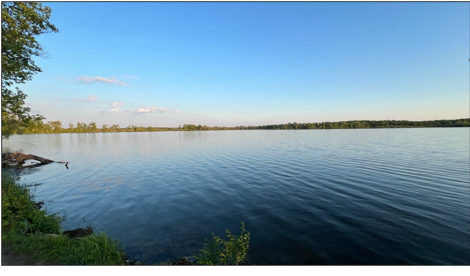
[A view of Lake Wingra from Vilas Park. Photo courtesy of Doe Han, 2024.]
Why Do Lakes Have Different Clarity and Colors?
Lakes come in a spectrum of blues, greens, and browns. And each color tells a story about what’s in the water. A lake’s color is shaped by a mix of dissolved substances and suspended particles, each revealing clues about its biology, chemistry, and surroundings.
Clear blue water generally indicates low levels of algae and sediment (see Table). Many deep, nutrient-poor lakes (known as oligotrophic lakes) appear blue because there’s little material to cloud the water. The blue hue comes from the way water absorbs and scatters light, absorbing longer wavelengths like red and reflecting shorter ones like blue. However, an important caveat: if a lake that once had more color or life suddenly becomes too clear, it may signal a problem, such as invasive mussels filtering out the base of the food web.
Brown lakes often get their color from tannins, natural organic compounds released as leaves, peat, or pine needles decompose in upstream wetlands. These “tea-stained” waters are common in forested or boggy regions and are usually completely harmless. In fact, the richness of the brown shade often reflects the amount of wetland in the watershed. A dark, coffee-colored lake may seem unusual if you’re expecting clear water, but it’s likely in great ecological health.
Green water typically comes from algae. Specifically, microscopic phytoplankton and cyanobacteria that contain chlorophyll, the green pigment responsible for photosynthesis. A light green tint can be normal and even beneficial, supporting a vibrant aquatic food web. But when the green becomes vivid, soupy, or scummy, it usually means a nutrient overload (often from phosphorus), fueling a harmful algal bloom. In summer, these blooms may appear as thick blue-green paint-like slicks caused by cyanobacteria. These can be toxic to both people and pets, so they’re one color you don’t want to ignore.
When lake water appears cloudy or opaque, it’s usually due to high turbidity, lots of suspended particles like silt, clay, or organic debris. After storms, sediment-laden runoff can turn a lake muddy brown, while wind or boat traffic in shallow lakes can stir up bottom sediments and temporarily reduce clarity.
Sometimes, lakes look like chocolate milk following a rainstorm. It is not dangerous, but a sign of erosion and possible ecosystem stress. Suspended sediments can smother fish eggs, block sunlight, and carry attached pollutants like phosphorus into the water. Still, some lakes are naturally turbid, particularly those influenced by clay-rich inflows or high microscopic life.
Table 1. Table of lake water colors and their common causes.
| Lake water appearance | Primary cause(s) | Scientific Definition |
| Clear, blue (or aqua) | Low algae Low suspended sediment Limestone or white lakebed Extensive bivalve activities | Oligotrophic1) lakes |
| Brown or tea-colored | High dissolved organic matter Can often seen in lakes near forests and wetlands | Dystrophic2) lakes |
| Green or pea-soup | High algae High phosphorous and nitrogen Pea-soup color/texture signals an algae bloom | Eutrophic3) lakes |
| Cloudy or murky | Suspended particles (sediment, debris) Boat waves stirring the lakebed Microscopic plankton/detritus | |
| 1)High oxygen, low plant nutrients, low productivity2)Low oxygen, high dissolved organic matter but low plant nutrients3)Varying to low oxygen, high plant nutrients, high productivity | ||
How Do We Measure Water Clarity?
Beyond just eyeballing the color, scientists and lake volunteers use several tools to measure water clarity and quality using various devices.
The simplest tool is a Secchi disk, a circular disk (approximately 8” in diameter) painted in black-and-white quadrants. It’s attached to a rope or pole and lowered into the water until it vanishes from sight. The depth at which the disk is no longer visible is the Secchi depth, which indicates how clear the water is. The deeper you can see the disk, the clearer the water.
While Secchi depth is a visual measure, turbidity is a more technical measure of water cloudiness. Turbidity is usually measured with an electronic turbidity meter or sensor, which shines light through a sample and detects how much is scattered. It’s quantified in NTU (Nephelometric Turbidity Units). In simple terms, “turbidity is a measure of water clarity” – high turbidity means the water is more cloudy or muddy.
To specifically gauge how much algae is in the water, scientists often measure chlorophyll-a. Chlorophyll-a is the primary green pigment in algae and aquatic plants. By taking a water sample and testing it (either by laboratory analysis or using fluorometric sensors), we can find the concentration of chlorophyll-a (usually in micrograms per liter; one liter = 1.06 quarts). Higher chlorophyll means more algae in the water. In fact, experts say one of the most accurate ways to measure algal abundance is by measuring chlorophyll-a in a sample. Many lake water quality reports include chlorophyll-a levels as an index of algae. If chlorophyll readings are high, the lake is definitely green with algae even if you can’t see it well.
When “Too Clear” Is a Warning Sign
While clear water is often seen as desirable, especially for swimming and boating, it can sometimes signal ecological trouble. One of the most striking examples is the invasion of zebra mussels and their close relatives, quagga mussels (see the accompanying article in this issue by David Ortiz). These small, invasive mollusks are incredibly efficient filter feeders: each one can filter over a liter of water per day, removing plankton and suspended particles. As they proliferate, they drastically increase water clarity, not by improving water quality, but by stripping the base of the aquatic food web.
In lakes where mussels have taken hold, people often marvel at the sudden, striking transparency. But the clarity comes at a cost. Lake Michigan and Lake Huron, for instance, became approximately 60% and 49% more transparent, respectively, over recent decades, largely due to mussel population explosions[3].
Other stressors can also degrade lake quality, even if the water looks clear. For example, the prolonged use of deicing agents (a.k.a. road salts) can raise chloride concentrations in nearby lakes. High chloride levels disrupt aquatic plant communities and can lead to the collapse of zooplankton populations. Without these tiny grazers, algae can proliferate unchecked, turning the water murky despite its previous clarity.
Peter Gascoyne of Friends of Lake Wingra has been monitoring chloride trends for years. “Lake Wingra’s chloride concentration is highly anomalous,” he warns, “and the rising trend compared to other lakes is very concerning.” His ongoing research into lakewater chemistry calls for continued investment in monitoring and protecting our urban lakes from invisible but significant threats.
What Can We Do as a Community?
Don’t judge a lake by its color alone. If you see brown water, don’t assume it’s polluted. In many cases, especially around marshes or forested areas, the brown tint comes from natural tannins—organic compounds released as leaves and plant material decay. The Minnesota Pollution Control Agency points out that this “bog stain” is typically harmless and has been part of the lake’s character for centuries. When in doubt, check with local environmental officials, but chances are, the lake is just doing what it’s always done, and supporting a healthy ecosystem.
Learn to read green water wisely. A little green in the summer isn’t unusual. It means algae are present, which form the base of the aquatic food web and support fish and zooplankton. However, if the water turns extremely green, smelly, or scummy, it may signal excess nutrient pollution or a harmful algal bloom (HAB). If your lake looks like pea soup or has blue-green, paint-like streaks, stay out of the water, keep pets away, and report it to the authorities. Cyanobacteria, the cause of many HABs, can produce toxins dangerous to humans and animals. In the long run, addressing nutrient pollution, such as runoff from fertilizers, requires community-wide efforts.
If every rainfall turns your lake a chocolate brown, it’s likely sediment, not just color. This indicates erosion somewhere in the watershed. Communities can take action by installing rain gardens, using sediment-control fencing at construction sites, and restoring streambanks to reduce soil loss. Planting native vegetation along shorelines and drainageways is another powerful way to filter out sediment before it reaches the lake. Reducing stormwater runoff helps keep the lake clearer, and also cuts down on pollutants like phosphorus that often hitch a ride on soil particles.
Limnologically speaking (that’s the scientific term for the study of lakes), maintaining the right chemical and biological balance in lake water is essential for a healthy ecosystem. Friends of Lake Wingra works continuously to protect and improve lake water quality, among many other efforts that benefit the lake and its surrounding community.
Sources and Further Reading
[1] Glowatz, E., Clean Water: Scientists Find Even Clear Lakes Contain Fertilizer Runoff, International Business Times. Retrieved April 14, 2025. https://www.ibtimes.com/clean-water-scientists-find-even-clear-lakes-contain-fertilizer-runoff-2599639
[2] Prince, C., A Moment of Clarity: Does Clear Water Mean Healthy Water? UF/IFAS Center For Aquatic And Invasive Plants Blog, Retrieved April 14, 2025. https://blogs.ifas.ufl.edu/caip/2021/06/22/a-moment-of-clarity-does-clear-water-mean-healthy-water
[3] Binding, C. E., Greenberg, T. A., Watson, S. B., Rastin, S., & Gould, J. (2015). Long term water clarity changes in N orth A merica’s G reat L akes from multi‐sensor satellite observations. Limnology and Oceanography, 60(6), 1976-1995.
For donations of water quality monitoring equipment or devices, please contact us at info@lakewingra.org.